After Baksheesh and Brahman, Campbell’s temperament improved on the second leg of his trip. The language is noticeably softer: a sad, lengthy passage about his fleeting encounter with a geisha.
Campbell landed in Tokyo on a rainy day of April 1955, via Sri Lanka (then Ceylon, the tea), Southeast Asia, Hong Kong, and Taiwan (then Formosa). There was the dream-like quality of late spring in Japan, like that in Akira Kurosawa’s Dreams first vignette (1990) – Campbell, returning from Hōrin-ji, a Shingon Buddhist temple outside Kyoto, on May 22:
“… the rain was falling as we walked from Hokkiji Temple to the bus, but the sun was shining. “We call this in Japan,” said Hisashi, “the marriage of the fox.”
Campbell’s mythological discussions, as always, are engaging.
“The basic teachings of the various Buddhist sects in Japan have been summarily formulated in four-word aphorisms which proliferate from each other in each system in amplification of the lore; e.g.”
| 即心是佛 Soku shin ze butsu This body is Buddha | Zen formula #1 (禪宗 / Thiền Tông) |
| 即身成佛 Soku shin jo butsu [That] this body [may] become Buddha | Shingon formula #1 (真言宗 / Chân Ngôn Tông) |
| 總別安心 So betsu anshin General [&] special peace [of] mind | Jōdo formula #1 (浄土真宗 / Tịnh Thổ Chân Tông) |
Zen is further divided into two mainstream practices. “Sōtō Zen follows the way of ri-ji-muge, meditation and monastic practice; Rinzai Zen follows the Kegon way of ji-ji-muge.”
ri ji muge (理事無礙 / 理事无碍 / lý sự vô ngại)
ji ji muge (事事無礙 / 事事无碍 / sự sự vô ngại)
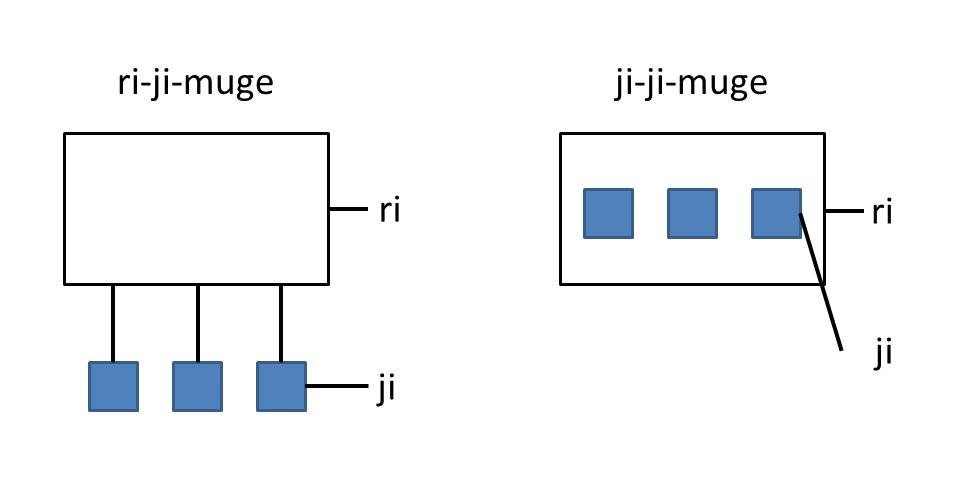
“Ri-ji-muge distinguished from ji-ji-muge
Ri stands for Reason, Principle, Noumenon, or Absolute.
Ji stands for the particular, phenomena, the objects of the universe.
Muge means unimpeded, undivided.
Ri-ji-muge means that the Noumenon and Phenomenon, the realm of the Absolute and that of Life and Dead are identical: undivided, unimpeded. In this school, however, one thing equals another only indidrectly, i.e., only because the two things are both identical with the one transcending ri and not because of the own essence…
Ji-ji-muge means, literally, “Phenomenon-Phenomenon-Undivided,” or more freely, the direct identity in essence of all phenomena.
While ri-ji-muge causes us to seek for the Buddha in the mind, the ji-ji-muge concept causes us to look for the Universal Buddha in the body. Following out the former idea [ri-ji-muge], the flesh is regarded as a shackle imprisoning the enquiring spirit, so that by retiring from the world one should reduce it to proper submission and thereby obtain enlightenment. With the ji-ji-muge school, however, illumination can be found only through perfecting the flesh by bringing out its latent potentialities, and thereby uncovering the Buddha hidden in the human heart.
I summed up the dichotomy by saying that ri-ji-muge is the Way of Sitting and ji-ji-muge the Way of Moving in the World, and both Eidmann and Takamine accepted this as OK.”
The tactile dimension of travelling adds depth to these conceptualizations:
“Our first visit when we reached the top of Mt. Hiei was to Jōdo-in, a small but important temple, within which is the tomb of Dengyo Daishi… We next visited in this temple the smaller Amida chapel. Here the paraphernalia of worship were of the Shingon type. The monk had to read here the Dai Hannya Sutra, which is stowed in a case just outside the chapel and consists of six hundred volumes. The main image in this chapel is a lovely standing image of Amida: it stands before a tabernacle, within which there is another image, black, supposed to have been carved by Dengyō Daishi himself. This image is almost never exposed. Somon himself has seen it only once. (Another example of Elen Psaty’s law: in Japan, the value of a thing is estimated by the fewness of people who have seen it.)
This chapel was small and dark and silent. The wind could be heard outside in the tall trees – and Mrs. Sasaki told me to try to imagine this place in the winter with the young priest performing his offices in the solitude and darkness. The whole spirit of [Tendai] was right here: the whole thing: the sense of solitude, darkness, and therein the Buddha’s apparition – a very different world from that of Zen, with its openness to the fair garden of the world. Even the incense, said Mrs. Sasaki, has a very different smell.”
Besides Buddhism and Shinto, indigenous worship is found during Campbell’s trip to Noboribetsu in Hokkaidō. How wonderful to experience all these religious varieties in one journey!
“In the village of Shiraoi, which we visited yesterday, one block, or section, is wholly Ainu. In all of Hokkaido, there are probably no more than one hundred full-blooded Ainus, but twenty thousand or so who participate in the Ainu culture. All but a dozen or so speak Japanese as well as Ainu. There are a number of Ainu dialects. No thorough study has been made of the language.
The bear sacrifice is the principal Ainu rite. The idea is, that the gods come to the Ainu as bears, but then cannot get out of their bear incarnations, unless killed. The rite returns the god to his proper form, and the meat and skin are left behind, to the Ainu, as a gift. The Ainu keep bears as pets; the women nurse the cubs. The pets then are sacrificed. Eidmann thought the ideas absurd – but I find here the [dema-divinity Hainuwele of the Celebes islanders]. Is there possibly an old Stone Age connection here, comparable to that of the Eskimo-Magdalenian continuity?”
Sake and Satori is an entertaining read, perhaps a good starter to find out if you’d enjoy reading Joseph Campbell. The only trigger warning is a controversial excerpt on Christianity, which is a bit much for me.



Leave a Reply