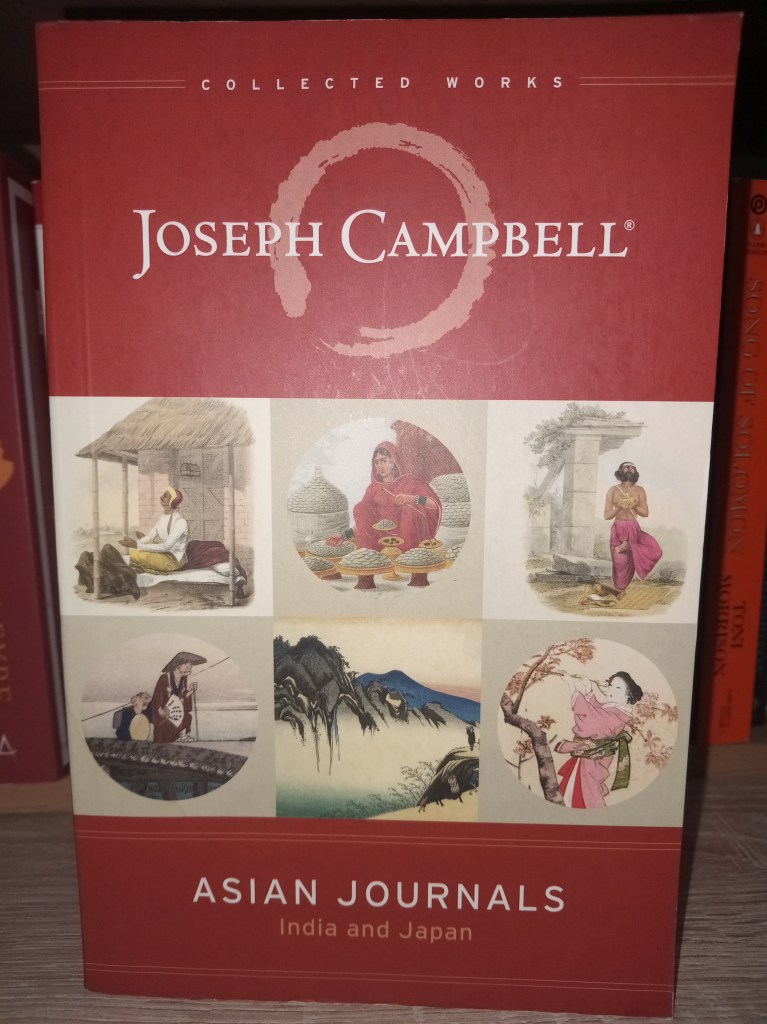
Joseph Campbell has been judged much, but hasn’t anyone.
Compared to his edited works on comparative mythology, Asian Journals is rougher to read. The diary started in 1954, five years after the publication of Campbell’s magnum opus The Hero with a Thousand Faces (1949) and over a decade after Heinrich Zimmer’s passing (1943). Zimmer was an exiled Jewish scholar and Campbell’s mentor, for whom he edited a stack worth of posthumous publications on Indian arts and religions. By the time Campbell finally made his maiden voyage bound for New Delhi in August 1954, via Beirut, Jerusalem, and Damascus, he had spent nearly two decades studying India and Sanskrit, purely from texts and artifacts accessible in US libraries and museums. A pretext for expectation management.
Ember after a forest fire was the general mood of the time. In Baksheesh and Brahman, morphing borders and millions of refugees still wandered the lands post-Partition (1947). In Sake and Satori, the Occupation ended formally in 1952. The beginning of Cold War and the ensued proxy wars. Political commentaries were inescapable, every other page.
In the first month of travelling, Campbell’s arid search for enlightenment or confirmation made the first hundred pages a struggle to read. Dismal poverty, observed by Campbell, walking the street of Calcutta, the morning of October 6, 1954:
“Surprise: I went at four to pay a small sum at the American Express, and sitting on the sidewalk, flat against the office-building, was an absolutely naked little black woman with buck teeth and grimace of disgust right leg out straight before her and left knee up against her left shoulder, leaving her yoni exposed and blazing red at the world. Over her left shoulder was a filthy piece of cloth, about the size of a face towel. Otherwise, as far as I could see, there wasn’t another woman in the city… nobody but myself even turned to look at this incarnation of Kālī. Well: in India it’s either too little or too much. And both leave you cold. In this case, however, I think the woman’s vagina was perhaps inflamed and that she was exhibiting her disability intentionally, just as the leper, some thirty yards further along the wall, was exhibiting his disabled hands. The first time I saw the woman – when I went into the American Express office she was sitting with her right side to the wall and her left knee up against her chin; as though, having taken off her shred of cloth, she were now waiting to get up the nerve to proceed to the next stage of her exposure. When I came out of the office, some fifteen minute later, the exposure was complete.”
An evening gathered in the dark with his friends, listening to Ravi Shankar on vinyl.
“In Sankrit two words appear, which designate two categories of the inherited Indian tradition, namely Śruti (“what is heard”) and Smṛti (“what is remembered”). The Vedic hymns belong to the former and braminical theological writings to the latter. Essentially, the priestly attitude represented in Smṛti, preserving the past, looking back and interpreting what has already been found, represents the attitude of le symbolisme qui sait – the analysis of “the fixed and the set fast” – whereas the poetical attitude that yielded Śruti, harkening to the voice of the living God, the Muse, represents le symbolisme qui cherche – “striving toward the divine through the becoming and changing”… I tend, therefore, to associate the work of the creative genius in art, literature, science and mathematics with the living, creative aspect of my subject, and the work of scholiast, priest, and academian (preserving, judging, and formulating rules on the basis of the created works of the past) with the dead and the anatomical or schematic.”
The political commentaries have Mearsheimer-ish vibe, which will be a turn off for some. Otherwise the reading experience will be worth the time invested, and the book gets more entertaining in Sake and Satori.
*Trigger warning: controversial language on a particular war crime.


Leave a Reply