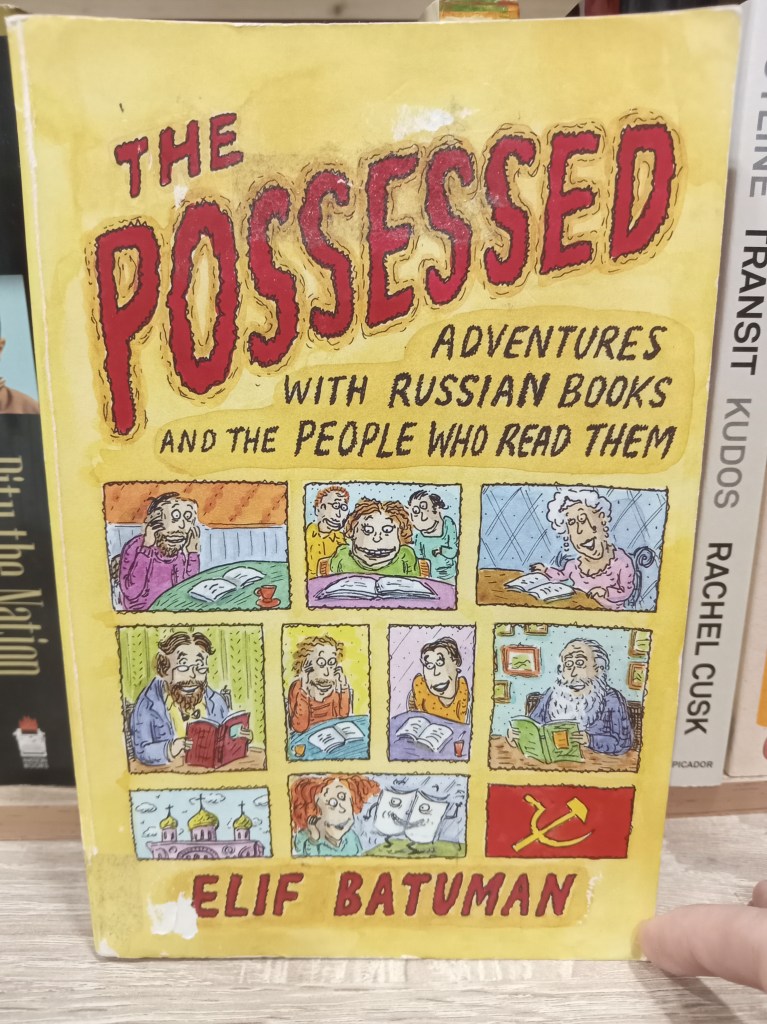
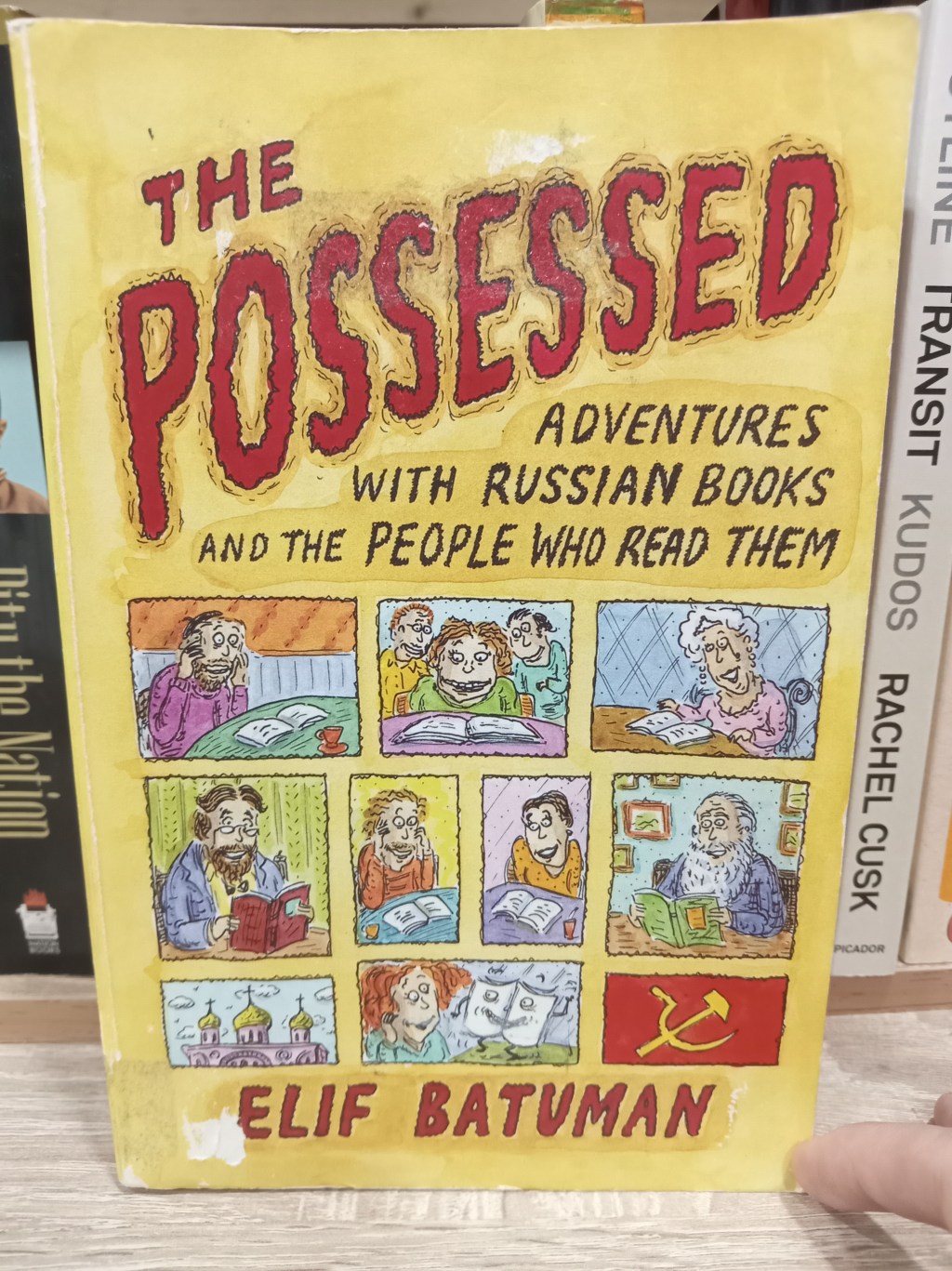
Reading brings back memories about people and places, even dead strangers and destinations who knows I will ever visit in this lifetime. I am staring at fragments of a land mass I’ve known only through maps printed on the index section. I might have been possessed by Elif Batuman’s possession, hopping through her years of grad school in Stanford and literary adventures out of the pages.
Our reading experiences exude the impression of a parallel universe, one that cannot exist inside an actual tour bus. The trailblazer Martha Gelhorn, for example, travelled to Moscow in 1972 to meet Mrs. M (Nadezhda Mandelstam, the widow of poet Osip Mandelstam who perished in Stalin’s gulag), only to come back disillusioned about the “universal obsession” that was modern Russia. My favorite grad school professor echoed this sentiment (beautifully written in Travels with Myself and Another, an excellent memoir and travelogue, the “other” was Hemingway, Gellhorn’s husband for a time). The professor went off the rails for a good ten minutes, in the middle of an M&A discounted cash flow model, about the treatments he and his wife received during their Moscow tour.
What Gellhorn called an obsession was Batuman’s “fascination with Russianness”. An accidental brush with a person, a book, a piece of music.
“The first Russian person I ever met was my teacher at the Manhattan School of Music, where I studied the violin on Saturdays. Maxim wore black turtlenecks, played a mellow-toned, orange-colored violin, and produced an impression of being deeply absorbed by considerations and calculations beyond the normal range of human cognition. Toward the end of one lesson, for example, he told me that he had to leave ten minutes early – and then proceeded to spend the entire ten minutes unraveling the tortuous logic of how his early departure wasn’t actually depriving me of any violin instruction. “Tell me, Elif,” he shouted, having worked himself up to an almost amazing degree. “When you buy a dress, do you buy the dress that is most beautiful… or the dress that is made with the most cloth?”
Another time, Maxim instructed me to listen to a particular Soviet recording of the Mozart violin concerti. Sitting in a wooden library carrel, I listened to all five concerti in a row: a fluid, elegant performance, with passages of singing intensity through which one seemed to glimpse the whole cosmic pathos of Mozart’s life on Earth. But as I listened, I found myself distracted by the CD case, by the slightly blurred three-quarters photograph of the soloist, who looked literally indistinguishable from my violin teacher. The stiff posture, the downturned mouth, the intent and melancholy eyebrows – everything was the same. His name was even Maxim, although he had a different surname.
The following week, Maxin specifically asked whether I had noticed anything unusual about the violinist.
“Like what?” I asked.
“Well, let’s say, his appearance. In Moscow, at the conservatory, people used to say that he and I looked alike… very much alike. More than brothers.”
“Actually, yeah – I did sort of notice that from the photograph.”
At this innocuous remark, an expression of gloom descended upon him, as abruptly as if someone had dropped a black cloth over his head. “It’s nothing, nothing,” he said, sounding almost angry.
Probably the strangest episode with Maxim involved the yearly juried examinations at the music school. In the weeks before the exams, Maxim was constantly changing his mind about which etudes and scales I should prepare, even telephoning me in the middle of the night to announce a change in plan. “We have to be very well prepared because we do not know who is on this jury,” he kept saying. “We do not know what they will ask you to play. We can guess, of course, but we cannot know.”
When the day of the juries came, I was called into the examination room, with its grand piano and long table, at the head of which, presiding over two more junior faculty members, say not some unknown judge, but Maxim himself.
“Hello, Elif,” he said pleasantly.” – Batuman recalls.
For me, there were three books. The first was Henri J. M. Nouwen’s “The Return of the Prodigal Son: A Story of Homecoming”. The elderly priest who taught Religion in high school had my class read this – books read in adolescence always leave a stronger impression. There was the obscure comfort of reconciliation and coming back home – when I was 15, alone, in a snow covered and ice glazed sealed off hole. A scrupulous carving was etched into memory, deeper still, a series of plain, animated frames of Nouwen – going to the Hermitage Museum in St. Petersburg almost everyday to sit in the chair set for him in front of Rembrandt’s The Return of the Prodigal Son. He looked at the painting for hours, nothing else among the treasure trove. It was something that I could see myself doing at 15: If I ever land in Russia one day, it will only be to rent a room walkable to the Hermitage, where they house Rembrandt’s The Return of the Prodigal Son, only to look at it for a whole day and I will be satisfied.
The second book was Colin Thubron’s “Where Nights are Longest: Travels by Car Through Western Russia”. I used to own the first edition published in 1984. The front cover was half-torn, in need of a tape surgery before I gifted it to my first love. I remember there was a passage in the book where Thubron wished to go on mushroom hunting with his Russian companion forever, but they couldn’t. At the time I could not find words elsewhere that conveyed my feelings to him any closer than these couple of lines.
Batuman writes about reading books that “one remembers together with the material circumstances of reading: how long it took, the time of the year, the color of the cover. Often, it’s the material circumstances themselves that make you remember a book that way – but sometimes it’s the other way around”. She remembers reading Babel in a rainy Saturday, while baking a Black Forest cake in her apartment overlooking the Safeway parking lot. The smell of rain and chocolate.
I remember reading War and Peace throughout the pandemic outbreak, on the long bench of a pavilion located somewhere along a curvaceous botanical walk in the Taipei Zoo. The situation in 2020 was relatively tamed for Taiwan, even though classes had migrated online (more reading and hiking time), lock-down wasn’t implemented until 2021. A ticket cost 30 TWD (a dollar) with a metro card, and I would buy a snack from the convenient store, an onigiri or milk toast, to spend an hour reading undisturbed. Visitors rarely frequented the zoo on this walk, only a quiet gardener who waved goodbye every time I descended the hill.
I read from spring to fall, when the air was chilly enough for a windbreaker until the humidity began to take over and large waterfowls returned to the nearby pond, flapping their wings to compete with the incessant buzzing of insects. I remember the first scenes, when Natasha’s mother was meeting her childhood friend to borrow money for the Rostov children – military uniforms for Nikolai and a gown for Natasha’s debutante. Simmering events in the world reminded me of people in the book, among them – the aging General Kutuzov who appeared and exited as needed, Prince Andrei who was too brilliant to survive further tempering of the soul. Natasha who found a happy ending in Pierre and Nikolai in Maria. But more searing were the sweet taste of milk toast and high-pitched ringing of the cicadas, which brought peace and joy more than any lessons acquired from the 1400 pages.
Batuman went on a wild goose chase to investigate Tolstoy’s death in Yasnaya Polyana – the seed of Tolstoy’s universe, the ancestral estate where he was born, lived most of his life, and is buried. If ever, I would also include in my very succinct itinerary a day cruising around Yasnaya Polyana.
Humorous flukes like the episode with Batuman’s violin teacher keep me on pace with her intimate and entertaining journey. Real life is sometimes stranger than fiction. In three chapters after Batuman had landed in Samarkand to learn Uzbek, she realized that the city was populated by Tajiks, whose vernacular leaned closer to Farsi than the Russian-Turkish infused version of modern Uzbek (which she was supposed to learn). Turns of events are always hilarious :)))) Yet there are also powerful reflections, such as the one below, recorded after the sergeant accompanied Batuman on a Turkish pilgrimage pressed her about studying Russian, instead of Turkish lit, at Harvard (Batuman is a first generation Turkish American):
“Looking back, I am surprised by how much I took to heart the words of people like this sergeant. If I didn’t actually believe in my responsibility to tell Americans the truth about Turkey, nevertheless I did feel it was somehow wasteful of me to study Russian literature instead of Turkish literature. I had repeatedly been told in linguistic classes that all languages were universally complex, to a biologically determined degree. Didn’t that mean all languages were, objectively speaking, equally interesting? And I already knew Turkish; it had happened without any work, like a gift, and here I was tossing it away to break my head on a bunch of declensions that came effortlessly to anyone who happened to grow up in Russia.
Today, this strikes me as terrible reasoning. I now understand that love is a rare and valuable thing, and you don’t get to choose its object. You just go around getting hung up on all the least convenient things – and if the only obstacle in your way is a little extra work, then that’s the wonderful gift right there.”


 Vu Thao
Leave a reply to Swamigalkodi Astrology Cancel reply