The Leavetaking has richest introduction I’ve read into 2025. Style, mood, pace, motif, symbol, characterization, on two sides of a page, I like it so much, here goes –
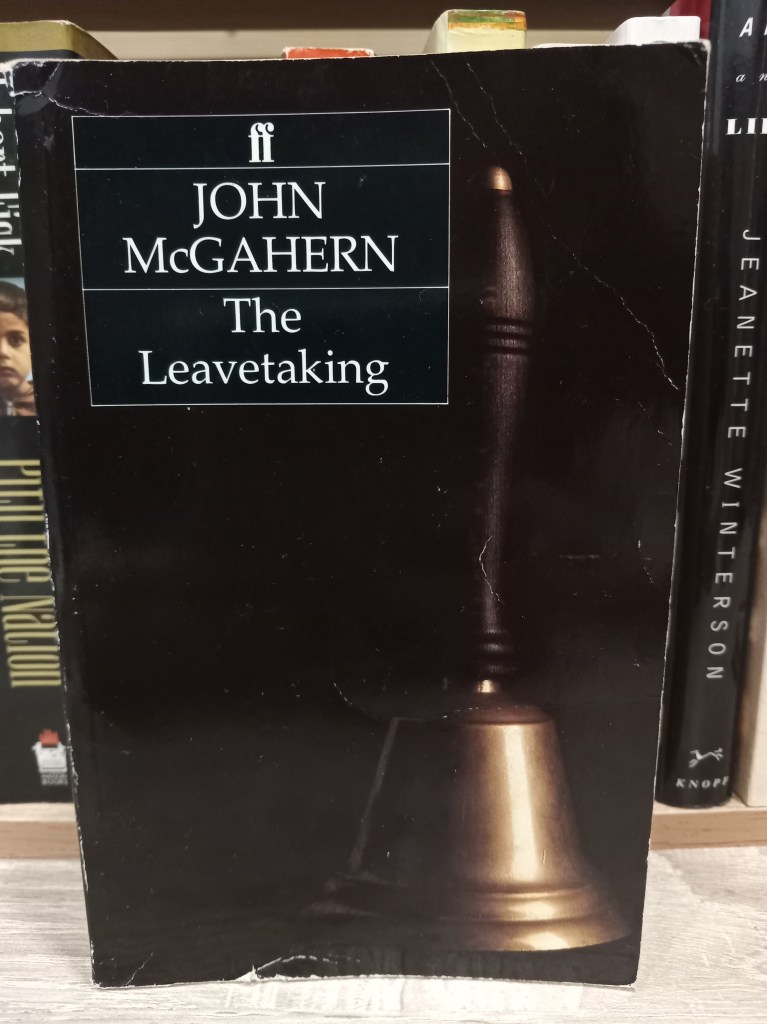
“I watch a gull’s shadow float among feet on the concrete as I walk in a day of my life with a bell, its brass tongue in my hand, and think after all that the first constant was water.
Two boys drag a small boy towards me through the milling bodies. He is sobbing. I have to lean forward to hear in the din.
“He says Billy Rudge has been throwing pebbles at his glasses, sir.”
“Tell Billy Rudge from me if it happens again he’ll go to the office.”
They run, gripping the small boy between them, who is smiling now behind the cheap misted spectacles. I hadn’t to think to answer. After all the years on the concrete everything had become mechanical now, comforting hand on hair or warning tap on shoulder, the Red Cross kit in the office, telephone for the ambulance when limbs were broken.
I turn to watch the shadows float, calmly crossing and recrossing the milling shoes and hanging for moments still, how calm and graceful they float or hang still: the air above full of squawking gulls, clumsily turning, the hanging stilts of the claws and the bootbutton eyes tacked to the side of the skull as they wait for the abandoned scraps of bread.
“Bhuil cead agan dul go dti an leithreas, a mhaistir?” a boy asks my permission to go to the lavatory.
“Why didn’t you go with your class when I rang the bell?”
“I forgot, sir.”
“Do you really need to go?”
“Not really, sir,” he grins and gallops away before I mechanically say, “Why did you ask then?” and I do not call him back but follow a floating shadow again, the brass tongue of the bell warm in my hand; and I shiver, once it had seemed it would go on lunchtime after lunchtime as this until I withered into a pension at sixty-five, and yet today is the last day I’ll walk with the bell. This evening he’ll dismiss me when I meet him at eight. A smell of urine seeps from the lavatories, their small windows half open under the concrete eave.
The shadows sweep over the concrete, violent and very fast; and I search for one slow shadow to follow before turning to the air, where the violent sweep of shadows is reflected in a white frenzy above as it nears to when they can fall on the scraps of bread.
I look on the shape of the buildings that on three sides enclose the concrete I walk on. The lavatories and schoolrooms are flatroofed and concrete, the single arm of the assembly hall alone v-roofed. Ragged rose bushes hang limp under its windows, a strip of black earth in concrete, the concrete beginning to crack after ten years, half-arsed modern as the rest of the country; the two halves of the yard slope in opposite directions. When it was first put down the plans had been read wrong and the slope had flooded the rains into the school, one half having to be torn up and sloped back towards the centre.
Across the low flat roofs of the schoolrooms I look towards the girls’ school, a nineteenth-century mansion framed in beeches. The iron stairs of the fire escape climb to the door and window where the women lunch, low in the window black hair I kissed once, woman that I loved once: that love has gone and both of us live on though it seemed death then. Now that her power has gone she blushes when we meet, she who was indifferent to me or bored when she had power, as if she feels the part of her life that is gone has been enclosed by my love and could be recalled if the love could. She blushes now that part of her life is gone with the love, and still we live on.”
The opening is set at the end, the last day of school for the narrator to be dismissed from his teaching post at an Irish school, for marrying a divorced American he met while on leave in London, the leavetaking to escape another fall out of the heart (a different episode after the black hair mentioned above). The narrative was guided by lost loves that shaped his life, push after shove, like waves crashing into the shore next to the small room where he slept in the last page of the novel.
Can an experience so carefully camouflaged and locked away – for one to go on living as a contributing member of society – be described in such compact and penetrating manner in every language. In Cole Porter, or when Tsai Chin (蔡琴) sang the classic 相思河畔.
John McGahern wrote more than a happy ending with The Leavetaking – a satisfying and highly approachable Irish novel.


Leave a Reply