David Watson (translator), 2001
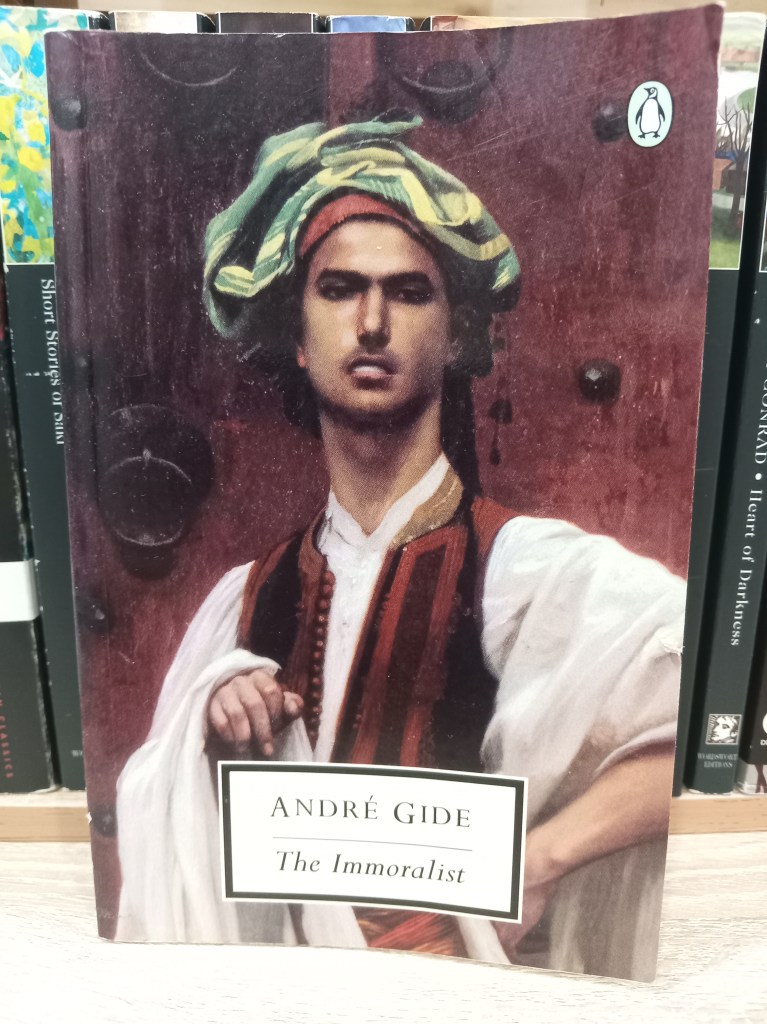
The Immoralist is different from the pilgrimages of War and Peace, or Moby Dick, for which stamina is needed. But somewhere along the line, you’d think that genius is of the same breed, 120 pages or 1400.
“The finest work of mankind is universally concerned with suffering. How would one tell a story of happiness? One can only tell the origins of happiness and its destruction. So far, I have told you of the origins.” – said Michel, (the immoralist, married, bisexual, upper-middle class academic), when he realized Anna Karenina’s train has left the station.
The story is as old as story telling – a narrator embarks on a journey that brings him from one end of the spectrum to the complete opposite, closing a circle. André Gide swung between polarized opposites like a second nature, smoother than silk. Necessitating the urge to do one thing really well.
I have made a note of the dichotomies and somehow the pendulum’s swing is never jarring. A beautiful combination of Cartesian dualism and António Damásio’s refute.
God-no God, one-two, unmarried-wedded, Paris-Tunis, perishing-revitalizing, night-dawn, man-woman, obedient-mischievous, sickly-healthy, clothed-naked, <a bearded, dusty scholar> vs. <a handsome, tanned youth>, mind-body, wild-civilized, ugly-beautiful, shame-pride, dead-alive, suffering-happiness, Syracuse-Normandy, foreign-home, master-servant, old-young, past-present, countryside-city, farm-university, frugal-lavish, present-future, orthodox-rebellion, society-solidarity, routine-uncertainties, scholars-fools, forced-free, possession-possessed, life-death, pure-damaged, Paris-Normandy, outsider-insider, thoughts-people, victim-trickster, loyalty-abandonment, Normandy-Syracuse, things-nothing, shawl-rope, ascetic-hedonist, dawn-night, boy-woman, hopeful-hopeless, present-past, beginning-terminal, woman-boy.


Leave a Reply