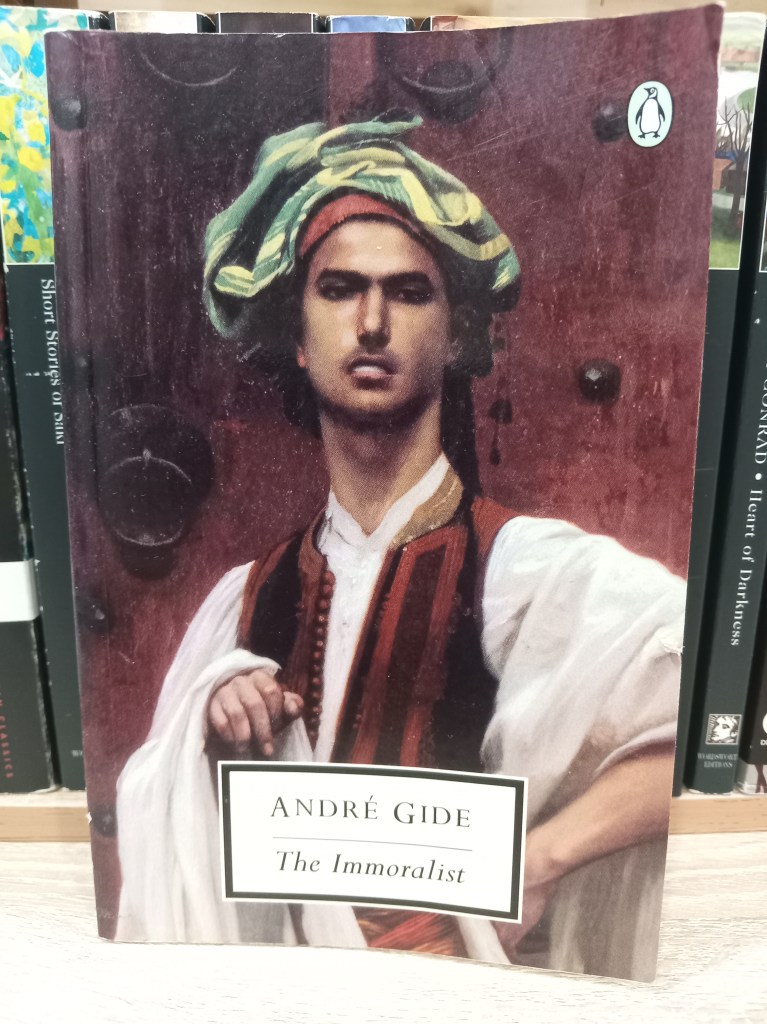
David Watson (translator), 2001
Is it a sprint or a marathon?
No, it’s a walk.
A walk is the trademark of a genius. You don’t need to dash (or limp) through the pages to get your money’s worth. [Some genius stuff is in the public domain, open source, anyway]. Like the park, the beach, the mountain, the best in life comes free and you are also free to leave anytime. Relax, there is a permanency to their presence, they will always be where you need them. But reading genius stuff definitely consumes. I was entertained, but dazed afterward.
The Immoralist is a stroll in the park. I want to linger for as long as possible, going back at different times of the day, in the spring and in the summer, to discover something new and beautiful every time. It is different from the pilgrimages of War and Peace, or Moby Dick, for which stamina is needed, and most people don’t plan to go to Rome, the Mecca, or Jerusalem every other year. But somewhere along the line, you’d think that genius is of the same breed, 120 pages or 1400.
“The finest work of mankind is universally concerned with suffering. How would one tell a story of happiness? One can only tell the origins of happiness and its destruction. So far, I have told you of the origins.” – said Michel, (the immoralist, married, bisexual, upper-middle class academic), when he realized Anna Karenina’s train has left the station.
The story is as old as story telling – a narrator embarks on a journey that brings him from one end of the spectrum to the complete opposite and, through this dichotomy, a full circle of life is realized. André Gide slides between polarized opposites like a second nature, smoother than silk. His most critical events, the most breathtaking imageries, take place in transit, at dawn. By doing one thing really well, that meticulous, consistent craftsmanship can elevate a simple motif to pure perfection.
I have made a note of the dichotomies and, even though they may seem endless, the pendulum’s swing is never jarring. It’s one of the most eloquent descriptions of Cartesian dualism I have ever read (up there with the refute, Descartes’s Error, by Antonio Damasio).
Forgot, the pairs:
God-no God, one-two, unmarried-wedded, Paris-Tunis, perishing-revitalizing, night-dawn, man-woman, obedient-mischievous, sickly-healthy, clothed-naked, <a bearded, dusty scholar> vs. <a handsome, tanned youth>, mind-body, wild-civilized, ugly-beautiful, shame-pride, dead-alive, suffering-happiness, Syracuse-Normandy, foreign-home, master-servant, old-young, past-present, countryside-city, farm-university, frugal-lavish, present-future, orthodox-rebellion, society-solidarity, routine-uncertainties, scholars-fools, forced-free, possession-possessed, life-death, pure-damaged, Paris-Normandy, outsider-insider, thoughts-people, victim-trickster, loyalty-abandonment, Normandy-Syracuse, things-nothing, shawl-rope, ascetic-hedonist, dawn-night, boy-woman, hopeful-hopeless, present-past, beginning-terminal, woman-boy.
There’s more.
The post is becoming longer than intended. It cannot capture the rapture of this book, neatly divided into two halves, the ending is the in-between. Novelists cannot resist writing about the spoiled – really :)) – always restless, unsettled, and wanting, no matter where they are or who they are with. So flawed, too human.
 Vu Thao
Leave a comment